

Beverage Market Studies: Ready-to-Drink Leads 9 Markets
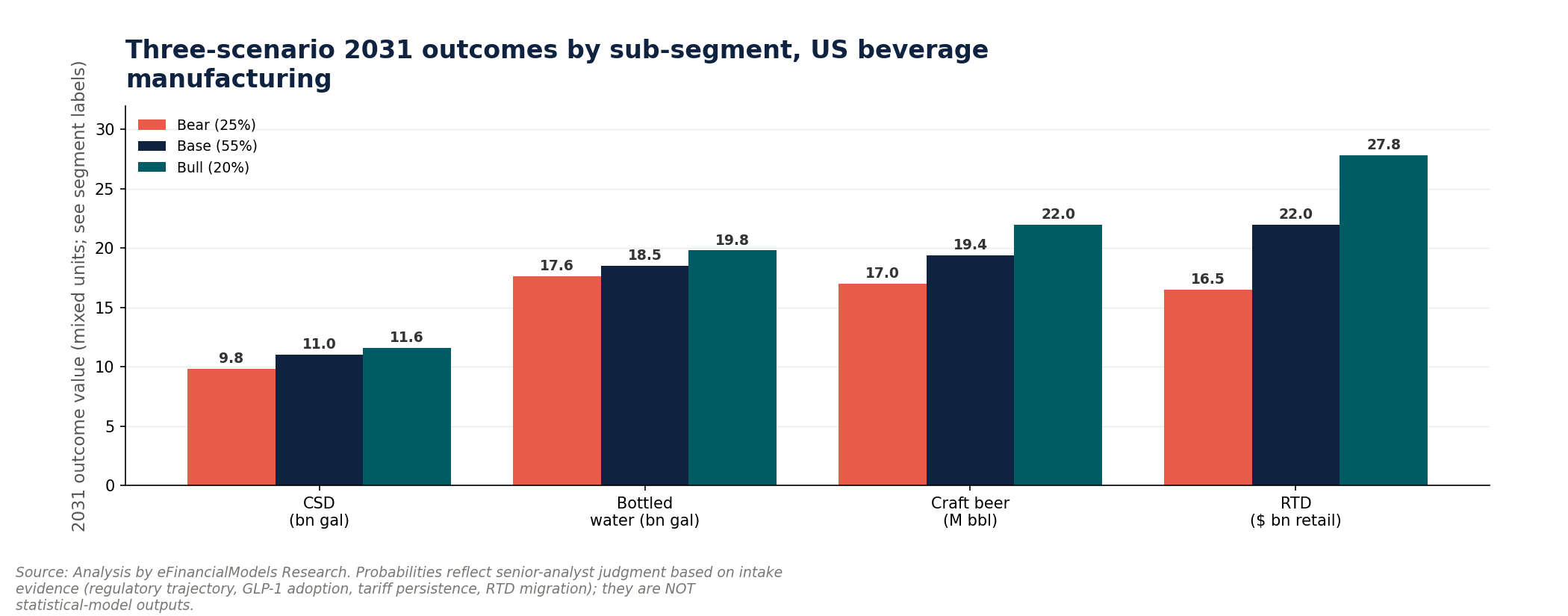
US beverage sub-segments at 2031 under bear, base, and bull scenarios; the studies put base-case ready-to-drink at USD 22.0 billion, ahead of carbonated soft drinks, bottled water, and craft beer. Source: eFinancialModels USA Beverage Manufacturing Market
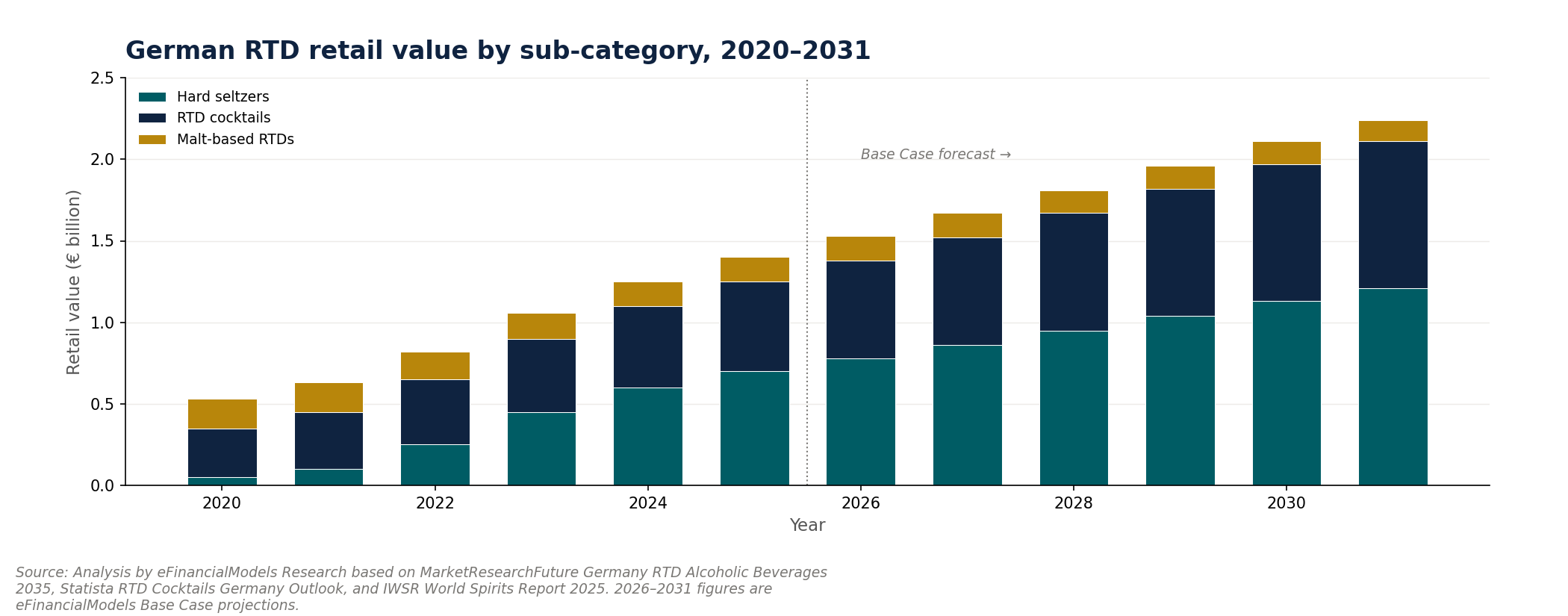
German ready-to-drink retail value rises toward EUR 2.2 billion by 2031 in the base case, led by hard seltzers and RTD cocktails, as reported in the studies. Source: eFinancialModels Germany Beverage Manufacturing Market Study.
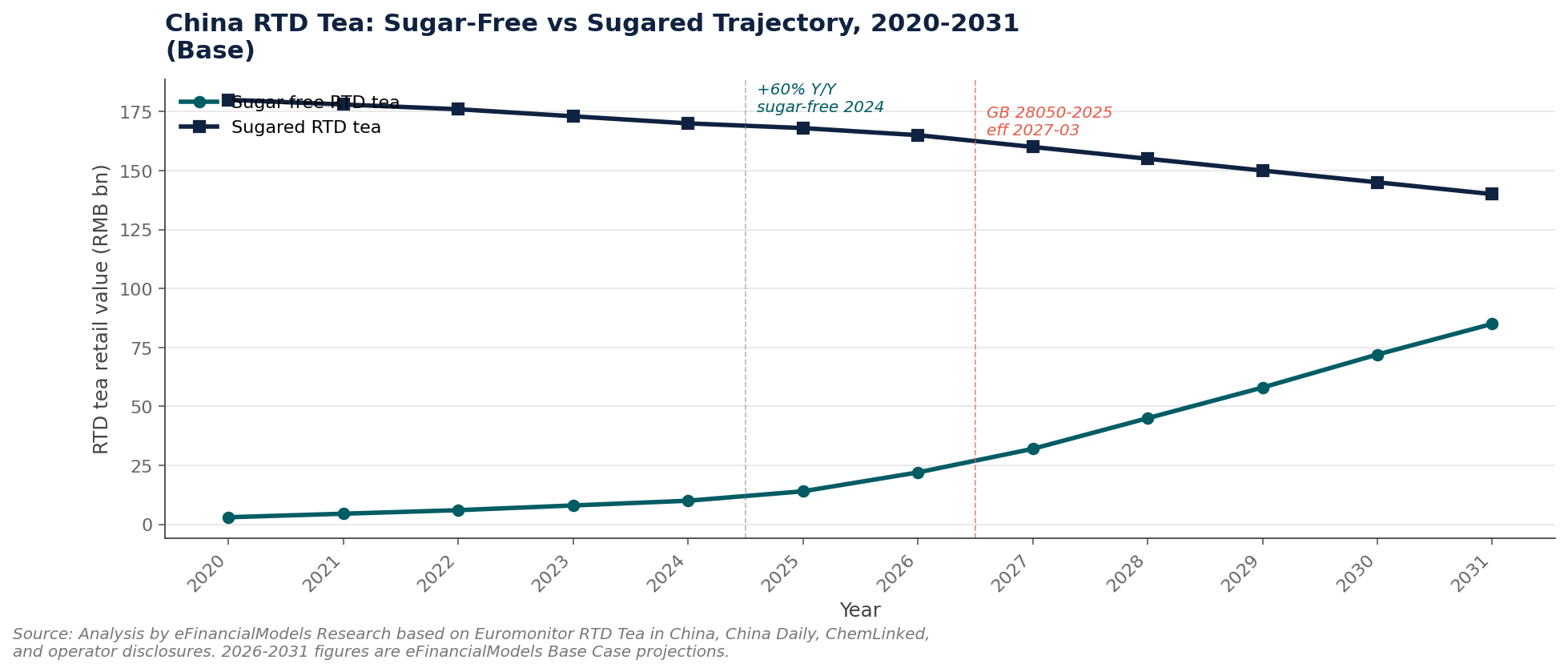
Chinese sugar-free RTD tea climbs while sugared RTD tea slips through 2031 in the base case, as reported in the studies. Source: eFinancialModels China Beverage Manufacturing Market Study.
Across nine Beverage Manufacturing Market Studies, the base cases to 2031 show consumers shifting spending from sugar and alcohol into ready-to-drink.
The studies note that the same framework runs across all nine markets, which lets the pattern be read as a cause rather than a coincidence. Volume is not disappearing in the base cases, the studies indicate; it is migrating, from sugary and full-strength formats into ready-to-drink, functional, and water, the categories where the moderating consumer spends. Each study carries a bear, base, and bull case with analyst-assigned probabilities of roughly 55 to 60 percent on the base, so the studies frame the migration as a planning range rather than a single forecast.
"The value of running the same three-scenario framework across nine markets is that you can see the cause, not just the trend. Volume is not disappearing, it is migrating, from sugary and full-strength formats into ready-to-drink, functional, and water, because that is where the moderating consumer spends. For an operator deciding where to put the next production line, knowing why the shift is happening is what makes it bankable." according to eFinancialModels Research.
KEY FINDINGS
- Ready-to-drink is where the spending lands. As drinkers moderate, the studies report they trade full-strength and full-sugar formats for convenient, lower-sugar ones, so RTD grows in the base case in Germany (EUR 1.0 billion to EUR 2.2 billion), the United States (to USD 22.0 billion), Australia (RTD spirits AUD 4.5 billion to AUD 7.7 billion), China (RTD tea USD 28 billion to USD 38 billion), and Japan (RTD tea 1.42 million kilolitres).
- Mature beer is declining structurally, not cyclically. The German study reports beer per adult falling from 105 to about 76 litres a year as consumers moderate and switch to alcohol-free, whose share climbs from 4.7 to 14.2 percent of the beer market, so total German beer eases from 78.0 to 70.8 million hectolitres in the base case.
- Sugary soda is being repriced, not falling on its own. The studies show US carbonated soft drinks holding at 11.0 billion gallons while bottled water reaches 18.5 billion, and Mexican soft drinks declining in every scenario, from 20.2 to 17.5 billion litres in the base case, after the 2026 IEPS reform the studies cite doubled the sugary-drink levy to MXN 3.08 per litre.
- Bottled water is the resilient default. In the United States the studies put base-case bottled water at 18.5 billion gallons, well ahead of carbonated soft drinks at 11.0 billion, because health trends reward it.
- Scenario ranges turn the pattern into a plan. Each study carries a bear, base, and bull case with analyst-assigned probabilities of roughly 55 to 60 percent on the base, so the studies let an operator size both the opportunity and the downside before committing capital.
How fast ready-to-drink replaces beer volume, how steep the per-capita decline runs, and how a taxed product reprices are, in the end, the inputs of a beverage financial model. The same studies that show where the growth moves give an operator the assumptions to forecast each scenario before committing capital. The full nine-country Beverage Manufacturing Market Studies and the underlying scenario financial model templates are available in the eFinancialModels Market Studies library.
Editor's note: eFinancialModels' Beverage Manufacturing Market Studies cover nine markets across Europe, North America, Latin America, Asia, Africa, and Oceania: Germany, France, the United States, Mexico, Brazil, China, Japan, Nigeria, and Australia. Each study models the market to 2031 under bear, base, and bull scenarios with analyst-assigned probabilities. Figures in this release are drawn from the studies' charts.
Communications Team eFinancialModels
eFinancialModels
info@efinancialmodels.com
Visit us on social media:
LinkedIn
Bluesky
Instagram
Facebook
YouTube
TikTok
X
Legal Disclaimer:
EIN Presswire provides this news content "as is" without warranty of any kind. We do not accept any responsibility or liability for the accuracy, content, images, videos, licenses, completeness, legality, or reliability of the information contained in this article. If you have any complaints or copyright issues related to this article, kindly contact the author above.
