

In Vitro Diagnostics Market to reach USD 189.72 Billion by 2035 at 6.72% CAGR
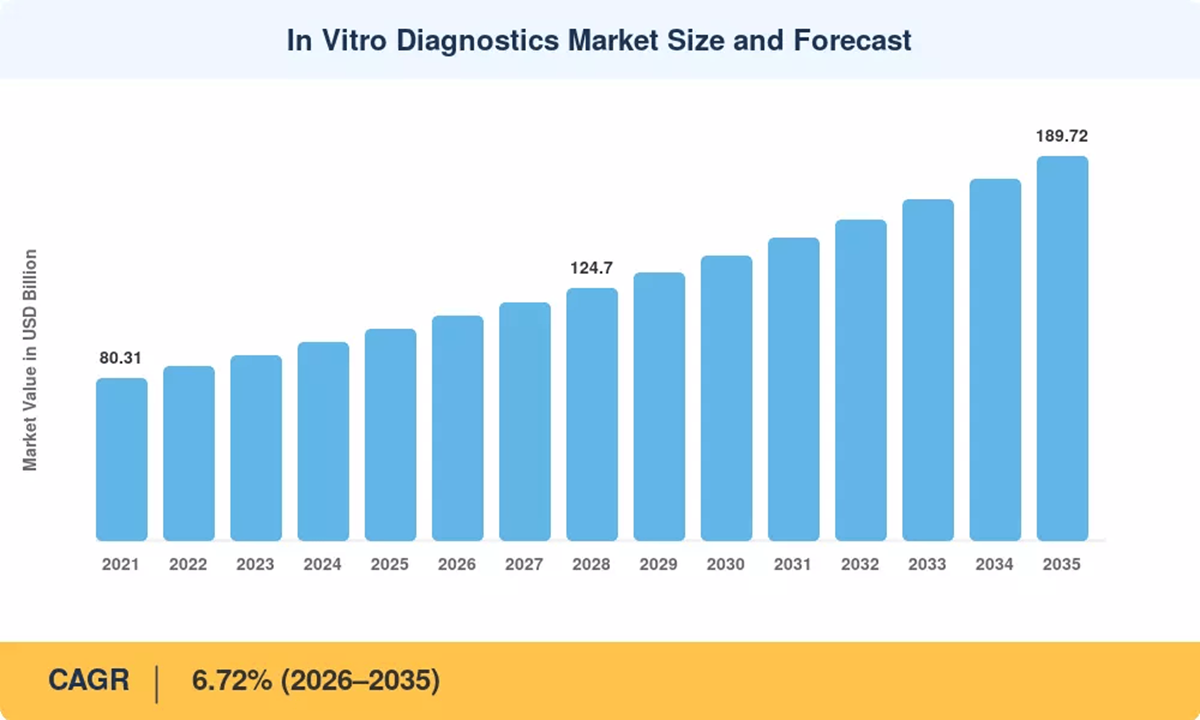
In Vitro Diagnostics Market Size
In Vitro Diagnostics Market to Surge from USD 110.94B in 2026 to USD 189.72B by 2035- By Rising Chronic Disease Prevalence, AI-Driven Laboratory Automation
NY, CA, UNITED STATES, July 13, 2026 /EINPresswire.com/ -- As per Market Research Future, the global In Vitro Diagnostics Market size to reach USD 189.72 Billion by 2035 from USD 110.94 Billion in 2026, at a CAGR of 6.72% during the forecast period 2026--2035. The market base was estimated at USD 104.18 Billion in 2025.The 6.72% CAGR---anchored by structural healthcare demand rather than discretionary spending---is driven by three converging forces: rising chronic disease prevalence that continues to widen the addressable patient base for laboratory diagnostic testing, sustained expansion of point-of-care diagnostic devices that is shifting blood sample analysis from centralized reference laboratories to community health posts, and AI-driven laboratory automation that has replaced legacy manual analyzers with fully integrated automation lines shortening turnaround times by up to 35%.
National governments and multilateral health organizations are amplifying this momentum. The International Diabetes Federation projects that 643 million adults will live with diabetes by 2030, up from 537 million in 2021, generating persistent demand for HbA1c and glucose monitoring through laboratory diagnostic testing channels. India's Ayushman Bharat program has catalyzed the procurement of over 150,000 point-of-care diagnostic devices across 160,000 health and wellness centers since 2023. Major health systems in the US and EU have invested more than USD 4.5 billion in laboratory consolidation initiatives that combine reagent rental contracts with decision-support software. Together, these initiatives are creating the procurement infrastructure and delivery innovation on which the In Vitro Diagnostics Market depends.
Request A Free Sample:
https://www.marketresearchfuture.com/sample_request/1165
Key Market Trends & Growth Drivers
Rising Chronic Disease Prevalence and Extended Testing Demand
The International Diabetes Federation projects that 643 million adults will live with diabetes by 2030, up from 537 million in 2021, generating persistent demand for HbA1c and glucose monitoring through laboratory diagnostic testing channels. Cardiovascular biomarker panels---including high-sensitivity troponin and NT-proBNP---have become standard admission protocols in over 4,200 US hospitals, each facility running an estimated 85,000 cardiac assays annually. This structural demand floor insulates the In Vitro Diagnostics Market from short-term funding cycles and ensures reagent pull-through regardless of pandemic-era testing volatility.
The WHO Global Cancer Observatory estimates that combined breast, prostate, and lung cancer diagnoses will surpass 8.5 million cases annually by 2030. Because chronic diseases---diabetes, cardiovascular conditions, and cancer---collectively account for over 70% of healthcare expenditure in OECD nations, this demographic wave mechanically expands the addressable population for clinical immunoassay kits, PCR-based diagnostic tests, and molecular diagnostics panels. Each percentage point of chronic disease prevalence gain translates into measurable prescription volume for laboratory diagnostic testing, and the embedded testing schedule in routine chronic disease management makes this driver structurally durable through 2035.
Expansion of Point-of-Care Diagnostic Devices
Legacy centralized reference laboratory models, long the default testing infrastructure, are giving ground to point-of-care diagnostic devices that deliver lab-grade accuracy outside traditional settings. India's Ayushman Bharat program has catalyzed the procurement of over 150,000 point-of-care diagnostic devices across 160,000 health and wellness centers since 2023. Similar decentralization programs in Indonesia, Nigeria, and Brazil are shifting blood sample analysis away from centralized reference laboratories toward community health posts. The WHO estimates that decentralized testing could reduce diagnostic turnaround for tuberculosis and HIV from 14 days to under 2 hours in rural sub-Saharan Africa, directly improving treatment initiation rates by 40%.
Pooled procurement through national health systems drives per-test prices down for high-volume clinical immunoassay kits, expanding access while compressing manufacturer margins. The convergence of connected home testing platforms with cloud-based laboratory information systems is creating integrated diagnostic networks that personalize patient monitoring at scale. By 2030, an estimated 60% of high-volume clinical laboratories in OECD countries will deploy machine-learning algorithms for pre-analytical screening, result validation, and auto-verification. In the US, point-of-care adoption is accelerating as urgent care clinics and retail pharmacies expand diagnostic capacity.
AI and Laboratory Automation
CMS's 2024 decision to extend PAMA reporting cycles and stabilize clinical laboratory fee schedule rates has provided reimbursement certainty for molecular panels and automated testing platforms. Cleveland Clinic's 2024 deployment of a fully automated core laboratory line demonstrated a 42% reduction in manual handling steps and a 28% improvement in sample-to-result time for clinical immunoassay kits. Middleware platforms incorporating machine-learning algorithms now flag pre-analytical errors---hemolysis, lipemia, icterus---before samples reach analyzers, cutting repeat-draw rates. The global laboratory automation segment attracted USD 2.1 billion in venture and strategic investment during 2023--2024, signaling confidence in the In Vitro Diagnostics Market's digitization runway.
The move from manual to fully automated blood sample analysis---as seen with integrated automation lines replacing legacy standalone analyzers---decreases turnaround time from hours to minutes per batch. Ambulatory diagnostic centers and community clinics are seeing a rising preference for automated platforms due to lower operating costs and higher patient throughput. This efficiency-driven adoption is expected to open up incremental revenue for the In Vitro Diagnostics Market in settings lacking specialized laboratory infrastructure. China's domestic IVD manufacturers---including Mindray, Snibe, and Maccura---have captured over 45% of the national reagent market, supported by centralized procurement policies that favor local suppliers. India's private laboratory chains are expanding into Tier 3 and Tier 4 cities, deploying point-of-care diagnostic devices connected through cloud-based laboratory information systems.
Ask for Customization:
https://www.marketresearchfuture.com/ask_for_customize/1165
Market Segment Insights
BY PRODUCT TYPE
Reagents & Kits: Dominant segment with ~50.4% revenue share in 2025. Reflecting the recurring consumable demand model that underpins laboratory diagnostic testing economics. Reagents and kits dominate the In Vitro Diagnostics Market because every installed analyzer generates ongoing consumable demand---a ratio of approximately USD 7--9 in reagent revenue for every USD 1 in instrument revenue over a platform's lifecycle. Hospital procurement teams treat it as a default supply category, and generic pricing has enabled broad adoption even in cost-sensitive emerging markets.
Software & Services: Fastest-growing product segment at 9.48% CAGR (2026--2035). Driven by AI-driven analytics and middleware integration. Laboratories are shifting from one-time license purchases to subscription-based laboratory diagnostic testing informatics platforms that include real-time quality monitoring and regulatory reporting modules. The convergence of diagnostic data with therapeutic decision-support is creating integrated platforms that personalize patient care at scale.
BY TECHNOLOGY
Immunoassay: Dominant technology with ~24.7% revenue share in 2025. Anchored by high-throughput clinical immunoassay kits deployed across hospital core laboratories. Immunoassay platforms---including chemiluminescence and enzyme-linked systems---remain the workhorse technology for cardiac, thyroid, and fertility testing volumes.
Molecular Diagnostics: Fastest-growing technology segment at 7.58% CAGR (2026--2035). Driven by expanding adoption of PCR-based diagnostic tests and companion diagnostics in oncology. The FDA approved 17 new companion diagnostic indications in 2024 alone, each tied to a targeted therapy that requires a validated PCR-based diagnostic test or immunohistochemistry assay before prescribing. Pharma-diagnostics co-development agreements are embedding molecular profiling into clinical trial protocols from Phase I onward.
BY APPLICATION
Infectious Diseases: Dominant application with ~38.6% revenue share in 2025. Generating approximately USD 43.8 billion. Respiratory panels, STI screening, and bloodborne pathogen testing sustain demand. Syndromic panels test for 20+ pathogens in a single cartridge, delivering results within 45 minutes versus 48--72 hours for traditional culture. Emergency departments using these panels report 22% reductions in empiric antibiotic prescribing.
Oncology: Fastest-growing application segment at 9.14% CAGR (2026--2035). Reflecting liquid biopsy innovations and targeted therapy biomarker assays. The liquid biopsy segment is projected to surpass USD 8 billion globally by 2030 as multi-cancer early detection tests gain clinical validation. PCR-based diagnostic tests and next-generation sequencing panels that analyze cell-free DNA from a simple blood draw are replacing invasive tissue biopsies in oncology monitoring.
BY END USER
Hospitals & Academic Labs: Largest segment with ~44.8% share in 2025. Comprehensive laboratory service lines and high-throughput testing requirements dominate volume. Hospitals remain the primary delivery site for laboratory diagnostic testing due to specialized infrastructure, quality control frameworks, and accreditation requirements.
Point-of-Care Sites: Fastest-growing end-user segment at 7.32% CAGR (2026--2035). Decentralized testing mandates and urgent care expansion drive demand as point-of-care diagnostic devices reduce the need for centralized laboratory capacity. Urgent care clinics, retail pharmacies, and rural health posts across Asia-Pacific and Africa increasingly prescribe decentralized testing options.
Read Detailed Insights:
https://www.marketresearchfuture.com/reports/in-vitro-diagnostics-market-1165
Regional Outlook
North America -- Dominant Market (~34.2% Share, 2025)
The United States generates approximately 83.4% of North American In Vitro Diagnostics Market revenue, driven by CMS's 2024 decision to extend PAMA reporting cycles and stabilize clinical laboratory fee schedule rates, commercial insurance coverage of molecular panels and companion diagnostics as standard-of-care, and broad reimbursement for clinical immunoassay kit regimens---a single policy ecosystem that converted a fragmented testing market into one with a structural preventive diagnostics tail. Medicare reimbursement for molecular panels under the clinical laboratory fee schedule has driven adoption in academic medical centers, while community oncology networks increasingly prescribe decentralized testing options to manage laboratory capacity. The US dominates through a combination of high per-patient spending, robust payer coverage, and rapid automation adoption.
Canada contributes through provincial laboratory consolidation programs at steady pace, while Mexico is growing at 6.18% CAGR on IMSS laboratory modernization investments at expanding scale. North America's leadership rests on reimbursement depth and the structural automation segment created by expanded laboratory consolidation mandates and value-based diagnostic contracts.
Europe -- Second Largest (~27.8% Share, 2025)
Europe's In Vitro Diagnostics Market reflects divergent national strategies---Germany leads regionally with a strong IVD manufacturing base and university hospital networks, contributing ~24.6% of regional share, while the UK historically used selective laboratory targeting before broadening coverage through NHS laboratory transformation programs at 7.12% CAGR. France contributes ~18.5% of regional share through biologie medicale reform and tiered testing networks. Italy is growing at 5.84% CAGR on regional health authority centralized procurement. Spain holds ~8.2% of regional share on public-private laboratory partnerships.
Harmonization pressure from the EU IVDR is gradually narrowing these differences, lifting baseline demand across the region. The European Commission's IVDR mandates equitable access to diagnostic testing across all member states. The Nordic countries are growing at 6.38% CAGR on digital health integration and biobank investments. Russia contributes USD 2.14 Billion on import substitution policy for diagnostic reagents. Centralized health technology assessment bodies---NICE, G-BA, and HAS---have progressively widened reimbursement for molecular diagnostics and companion diagnostics across disease areas.
Asia-Pacific -- Fastest-Growing Region (7.82% CAGR, 2026--2035)
Asia-Pacific is the engine of the In Vitro Diagnostics Market. China holds the largest regional share with ~38.2% of regional revenue, driven by domestic IVD manufacturer expansion and Healthy China 2030 initiatives---instantly extending laboratory diagnostic testing coverage through centralized procurement policies that favor local suppliers. India is growing at 8.94% CAGR on the back of Ayushman Bharat and the growth of private laboratory chains. Japan contributes USD 7.46 Billion through NHI pricing for precision medicine initiatives at steady pace. South Korea is growing at 7.28% CAGR on MFDS regulatory modernization.
ASEAN economies are growing at 8.48% CAGR on universal health coverage expansion. The rest of Asia-Pacific holds ~11.6% of regional share on public health surveillance investments. The region's combined contribution anchors the global volume base for laboratory diagnostic testing demand. Asia-Pacific represents the highest-growth opportunity, driven by a confluence of rising chronic disease incidence, urbanization, and government investment in diagnostic infrastructure.
Middle East & Africa -- Emerging Opportunity (8.14% CAGR, 2026--2035)
The Middle East & Africa is bifurcated between well-funded Gulf states and resource-constrained Sub-Saharan nations. Saudi Arabia leads the region with Vision 2030 healthcare cluster development, contributing ~28.6% of regional share---NEOM health cluster and the UAE's Cleveland Clinic and Mayo Clinic affiliations have created pockets of excellence for laboratory diagnostic testing. The UAE is growing at 6.94% CAGR on medical tourism and premium laboratory services. South Africa contributes USD 1.28 Billion on National Health Laboratory Service infectious disease surveillance.
Egypt is growing at 8.62% CAGR on Universal Health Insurance System rollout. WHO-supported disease surveillance networks underpin demand across the rest of the region. Diagnostic infrastructure gaps in LMICs remain a restraint---Sub-Saharan Africa and Southeast Asia together have fewer than 1.5 clinical laboratories per 100,000 population, compared with 11.2 in Western Europe. These gaps lead to delayed diagnosis and treatment initiation, indirectly narrowing the In Vitro Diagnostics Market addressable population.
Competitive Landscape and Recent Developments
The In Vitro Diagnostics Market exhibits medium concentration, with the top five players commanding an estimated 48--55% of global revenue. The Herfindahl-Hirschman Index falls within the 800--1,200 range, indicating a moderately concentrated structure where multinational incumbents compete with an expanding cohort of regional specialists. Competitive differentiation increasingly hinges on integrated service bundles rather than standalone instrument sales.
The competitive landscape is stratified between immunoassay platform pioneers serving global laboratory diagnostic testing markets, molecular diagnostics specialists capturing companion diagnostic tenders, and emerging-market challengers consolidating the value-positioned reagent segment.
KEY COMPANIES AND RECENT MILESTONES
Roche Diagnostics (September 2024): Launched the cobas Respiratory flex test, the first assay utilizing its proprietary TAGS multiplexing technology. The syndromic panel runs on existing cobas 5800, 6800, and 8800 molecular systems, expanding testing capacity without requiring hardware upgrades. Vertically integrated pharma-diagnostics model, commanding ~14--17% of global In Vitro Diagnostics Market revenue.
Abbott Laboratories (June 2024): Received FDA 510(k) clearance for three new Alinity clinical immunoassay kits targeting Alzheimer's blood biomarkers (p-tau 217), marking a milestone for neurodegenerative disease laboratory diagnostic testing. Broad POC-to-core laboratory portfolio, holding ~10--13% of global revenue.
Siemens Healthineers (March 2024): Completed acquisition of Varian's diagnostic imaging AI assets and announced integration roadmap with Atellica laboratory automation platforms, linking radiology and pathology workflows. Automation and digital health integration positioning, holding ~8--11% of global revenue.
Future Outlook: 2026--2035
By 2030, precision diagnostics and companion testing will become the operating system of disease management. The convergence of companion diagnostics and targeted therapy will reshape the In Vitro Diagnostics Market through the late 2020s. By 2030, an estimated 60% of high-volume clinical laboratories in OECD countries will deploy machine-learning algorithms for pre-analytical screening, result validation, and auto-verification.
The FDA's 2024 framework for phased oversight of laboratory-developed tests ensures clinical validity data for high-risk assays by 2028. Machine-learning models that integrate genomic, proteomic, and imaging biomarkers can recommend optimal testing protocols for individual patients. Start-ups have raised over USD 800 million in venture funding for oncology decision-support tools since 2023.
More Related Research Insights:
https://www.marketresearchfuture.com/reports/veterinary-orthopedic-market-33298
https://www.marketresearchfuture.com/reports/cushing-syndrome-diagnostic-treatment-market-42303
https://www.marketresearchfuture.com/reports/functional-near-infrared-optical-brain-imaging-market-42452
https://www.marketresearchfuture.com/reports/muscle-relaxant-drug-market-42554
https://www.marketresearchfuture.com/reports/enzyme-replacement-therapy-market-40978
https://www.marketresearchfuture.com/reports/fluoroscopy-market-42569
https://www.marketresearchfuture.com/reports/sacral-nerve-stimulation-market-43463
https://www.marketresearchfuture.com/reports/clinical-risk-grouping-solutions-market-9181
https://www.marketresearchfuture.com/reports/pediatric-ent-market-67523
https://www.marketresearchfuture.com/reports/gout-therapeutic-market-42378
Larry Wilson
WantStats Research And Media Pvt. Ltd.
+1 855-661-4441
email us here
Visit us on social media:
LinkedIn
Facebook
YouTube
X
Legal Disclaimer:
EIN Presswire provides this news content "as is" without warranty of any kind. We do not accept any responsibility or liability for the accuracy, content, images, videos, licenses, completeness, legality, or reliability of the information contained in this article. If you have any complaints or copyright issues related to this article, kindly contact the author above.
